Concrete floors look easy to clean — but they hold pet odours far longer than carpet does. The best carpet cleaner for pet messes on concrete floors is an enzymatic formula with enough dwell time to penetrate the pores. Here’s exactly what works, and why, in 2026.
- Concrete is porous — pet urine wicks into the surface and forms uric acid crystals that standard cleaners cannot reach.
- Enzymatic formulas are the most effective option because they break down those crystals at a molecular level, not just mask the smell.
- DIY solutions (vinegar, baking soda, hydrogen peroxide) can handle fresh accidents but rarely eliminate set-in stains completely.
- Always choose a pH-neutral, ammonia-free formula — ammonia can draw pets back to the same spot and etch polished concrete over time.
Why Do Concrete Floors Hold Pet Odours Longer Than Carpet?
Concrete looks solid and impermeable, but it isn’t. The material is genuinely porous at a microscopic level. It contains a network of capillaries and micro-voids that form naturally as the concrete cures. When a pet has an accident, liquid doesn’t just sit on top. It wicks down into those pores within minutes — often before you’ve had a chance to respond.
What happens next is the root of the persistent odour problem. As the liquid dries, the water evaporates but the waste compounds remain. Urea breaks down into ammonia — the sharp, immediate smell. Beneath that, uric acid forms crystals that bond to the concrete surface at a molecular level. These crystals are insoluble in water. They don’t respond to standard soap-and-water cleaning. They can sit dormant for weeks or months — then, when humidity rises or the floor gets wet, they reactivate and release odour as if the accident just happened.
This reactivation cycle is why so many pet owners find that concrete floors seem to smell worse over time, even after regular cleaning. Each surface clean removes visible contamination but leaves the crystalline layer in the pores intact. Research into concrete material properties confirms that even polished or sealed surfaces develop micro-cracks over time. These cracks open new pathways for liquid to penetrate. A UV blacklight torch used in a darkened room typically reveals a stain area that extends well beyond the visible mark — that’s the subsurface contamination surface-only cleaners never reach.
Understanding this is the key to choosing the right product. You’re not just cleaning a surface. You’re treating a porous material that has absorbed and retained a biological contaminant at depth. The cleaner you choose needs to penetrate, not merely sit on top.

What Should You Look for in a Cleaner for Concrete Floors?
Not every cleaner that works on carpet will work on concrete. The formula matters more than the brand name or the marketing on the label. Here are the properties that actually make a difference.
Enzymatic activity
This is the single most important factor for concrete. Enzymes are biological catalysts that accelerate specific chemical reactions — in this case, breaking down the organic compounds in pet waste. A cleaner with enzymatic activity doesn’t just lift the mess. It chemically dismantles it. Protease enzymes attack proteins. Urease breaks down urea. Oxidase enzymes target the pigment molecules that cause staining. The best pet mess cleaners use a multi-enzyme blend to cover all of these, which is why they consistently outperform conventional formulas on porous surfaces.
pH neutrality
Strongly acidic or alkaline cleaners can etch concrete surfaces with repeated use — particularly polished or decorative finishes. For regular maintenance, look for pH-neutral or near-neutral formulas (pH 6–8). For a one-off deep treatment of severely contaminated concrete, a stronger formula is acceptable. Rinse the surface thoroughly afterwards and don’t repeat it regularly.
No ammonia
Pet urine already contains ammonia compounds. Any cleaner that uses ammonia as a primary active ingredient can act as a scent signal — actually attracting pets back to the same spot. Check the ingredients list. Some older multi-surface cleaners still contain ammonia. It’s worth a few seconds to verify before you buy.
Pet safety rating
Not all “pet cleaners” are safe while pets are present. Many require the area to be kept clear until the product has fully dried. Some contain compounds that are toxic to cats and dogs even in diluted form — certain essential oils (tea tree, eucalyptus, pennyroyal) are common examples in products that rely on natural antimicrobials. Always check the label for drying time and specific warnings about pet proximity. The complete pet owner’s safety guide to carpet cleaning covers the key ingredient categories to check before using any formula in a space your pets access regularly.
Are Enzymatic Cleaners Really the Best Option for Concrete?
Yes — and the science explains exactly why. Enzymatic cleaners target the specific compounds that cause both staining and persistent odour. Other cleaners can remove visible contamination. Enzymatic formulas can eliminate the invisible crystalline residue that causes the smell to return after every damp day.
Products like Nature’s Miracle Advanced Stain and Odour Eliminator, Rocco & Roxie Professional Strength, and Simple Solution Pet Stain and Odour Remover all use bio-enzymatic formulas. They continue working for several hours after application — the enzymatic process stays active as long as the surface remains moist. This is why dwell time is so critical. A quick spray-and-wipe activates the enzymes briefly but doesn’t give them time to penetrate the pore structure or break down deeply bonded crystals.
For concrete specifically, the application method is as important as the product choice. Apply enough solution to visibly saturate the stained area. Don’t just mist the surface. Then cover the area with a damp cloth or plastic sheeting and leave it for at least 15–20 minutes, or up to several hours for old stains. The moisture prevents premature evaporation and keeps the enzymatic reaction running at full efficiency.
One practical note: enzyme activity slows significantly below 10°C (50°F). If you’re treating a concrete floor in an unheated garage or basement during winter, either warm the space first or extend the dwell time considerably to compensate for the reduced reaction rate.
If you want to compare specific enzymatic products and understand how their enzyme strains differ, the guide to the best enzymatic cleaners for pet messes breaks down active strains, application methods, and performance across different surface types in thorough detail.
✔ Pros of Enzymatic Cleaners
- Eliminate odour at a molecular level — not just mask it
- Effective on old, set-in stains with repeated application
- Most formulas are pH-neutral and safe for sealed concrete
- Continue working after application while the surface stays moist
- Generally safe for pets once fully dried
✗ Cons of Enzymatic Cleaners
- Require proper dwell time — quick wipe-ups won’t activate the process
- Less effective in cold temperatures
- Old stains may need multiple treatments over several days
- Tend to cost more per application than basic sprays
Can DIY Solutions Work on Concrete Pet Messes?
For fresh accidents, yes — a DIY approach can genuinely work. The key phrase is “fresh accidents.” Once uric acid crystals have had time to bond with the concrete, home remedies become progressively less effective with each passing hour.
The most practical DIY method for a fresh mess uses three stages. First, blot up as much of the liquid as possible with paper towels — don’t rub, which spreads contamination further. Second, apply a diluted white vinegar solution (equal parts vinegar and water) to the area. Vinegar’s mild acidity helps neutralise alkaline compounds in the urine and provides some antimicrobial action. Leave it for five minutes, then blot dry. Third, sprinkle baking soda generously over the damp area and leave it overnight. Baking soda is a natural odour absorber. Sweep or vacuum it up in the morning.
For a stronger DIY option on light staining, a 3% hydrogen peroxide solution — the standard drugstore concentration — mixed with a small amount of dish soap can lift remaining pigment via oxidation. Apply, let it sit for 10 minutes, scrub with a stiff brush, and rinse thoroughly. Always test on an inconspicuous area first. Hydrogen peroxide can slightly bleach some coloured or decorative concrete.
The honest limitation is that none of these solutions contain enzymatic activity. They can neutralise surface compounds and reduce immediate odour. They won’t break down the deep-set uric acid crystals that cause the smell to keep returning. For any stain more than a couple of hours old — or any floor with repeated accidents — a commercial enzymatic product will consistently outperform a home recipe. If you prefer to keep things natural around your pets, the collection of tested DIY pet cleaning formulas on this site includes five recipes with honest guidance on when each one is and isn’t sufficient.
✔ Pros of DIY Solutions
- Inexpensive — most ingredients are already in the kitchen
- No synthetic chemicals — good if you prefer natural products
- Safe for pets immediately after the area dries
- Effective as a first response for genuinely fresh accidents
✗ Cons of DIY Solutions
- No enzymatic activity — deep-set odour will return
- Ineffective on old or set-in stains
- Require considerably more scrubbing than commercial formulas
- Hydrogen peroxide can bleach coloured concrete — test first
Spray Cleaners or Machine Cleaners — Which Performs Better on Concrete?
The right choice depends on how much floor you’re dealing with and how often accidents happen.
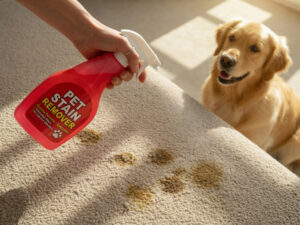
Spray cleaners are the practical choice for most households. They’re affordable, easy to store, and can be applied the moment an accident happens. For spot treatment of concrete floors, a good enzymatic spray — applied with proper dwell time and a scrub brush — handles most situations effectively. For single-room spaces or occasional accidents, a quality spray formula is all most pet owners need.
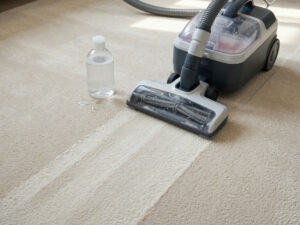
Machine cleaners — such as the Bissell Professional Pet Urine Eliminator range — become worth the investment when you have a large area to cover, multiple pets, or accidents that happen frequently. These machines inject cleaning solution under pressure into the surface and then extract it along with the dissolved contamination. That extraction step is particularly valuable on concrete. It physically removes what the enzymatic process has broken down, rather than leaving the residue to slowly evaporate from the surface.
A critical check before using any machine on bare concrete: not all carpet cleaning machines are suitable for hard floors. Some are designed specifically for carpet fibres and may not make proper contact with a flat surface. Check that the machine either has a hard-floor attachment or explicitly states hard-floor compatibility. Using the wrong machine on concrete can leave behind cleaning solution residue — creating a sticky film that attracts dirt and can worsen the smell over time.
If you’re also dealing with pet messes on tiles, polished stone, or hardwood alongside concrete, the guide to carpet cleaners for pet messes on tile and hardwood floors covers the hard-floor attachment question in practical detail — much of that guidance applies directly to concrete as well.
How Do You Tackle Old and Set-In Pet Stains on Concrete?
Old stains require patience and a methodical approach. Once uric acid crystals have bonded with concrete for weeks or months, a single quick treatment rarely achieves a complete result. The following step-by-step process gives you the best chance of full elimination.
- Map the full contamination area. In a darkened room, use a UV blacklight torch. Pet urine fluoresces under ultraviolet light, showing you the true extent of the stain. The illuminated area is often significantly larger than the visible mark. Treat the full area — not just the visible centre — or the smell will keep returning from the untreated edges.
- Remove surface debris first. Sweep or vacuum the area thoroughly. Any dust, dried matter, or debris creates a barrier between the cleaner and the concrete, reducing penetration and effectiveness.
- Apply the enzymatic cleaner generously. Don’t mist — saturate. Apply enough solution that the surface is visibly wet across the full stain area. The cleaner needs to penetrate to at least the depth the urine reached, which means a generous, wet application rather than a light spray.
- Extend the dwell time significantly. For old stains, cover the treated area with plastic sheeting or a damp towel to keep the enzymes active. Leave for a minimum of 30 minutes. For severely contaminated areas — or stains that have been present for months — leave the cleaner working overnight.
- Agitate with a stiff brush. After the dwell period, work the cleaner into the surface firmly with a stiff-bristled brush before rinsing. This helps break up any remaining crystalline deposits at the concrete surface and improves the final rinse-out.
- Rinse thoroughly and dry completely. Residual cleaner left in the pores can attract dirt and leave a sticky surface. Rinse with clean water and allow the area to dry fully before assessing whether another treatment is needed.
- Repeat if necessary. For very old or heavily contaminated areas, two to three treatments over consecutive days often achieves what a single application cannot. Reassess with the UV blacklight between treatments to track progress and confirm where further work is needed.
- Seal the concrete after full decontamination. Once the floor is completely clean and dry, applying a concrete sealer dramatically reduces future porosity. Subsequent accidents will largely sit on the sealed surface rather than wicking into the concrete — making them far easier to clean quickly.
For urine specifically — which causes the most persistent concrete odour because of the uric acid crystallisation process — the guide to the best carpet cleaners for pet urine in 2026 covers the formulas with the strongest uric acid-breaking capability, including which ones perform well on hard, non-carpet surfaces.

How Do the Main Cleaner Types Compare at a Glance?
Here’s a side-by-side breakdown of the major cleaner categories for concrete pet messes — what each one does well and where it falls short.
| Cleaner Type | Best For | Fresh Accidents | Old Stains | Concrete Safety | Pet Safety |
|---|---|---|---|---|---|
| Enzymatic Spray | Spot treatment, all-round use | Excellent | Good (repeat applications) | Safe — pH-neutral formulas | Safe once fully dry |
| DIY Vinegar / Bicarb | Fresh accidents, immediate response | Good | Poor | Safe when diluted | Safe |
| DIY Hydrogen Peroxide (3%) | Light surface staining | Good | Fair | ⚠ Can bleach coloured concrete | Safe once dry |
| Machine Extractor | Large areas, frequent accidents | Excellent | Excellent | Safe — check hard-floor compatibility | Depends on solution used |
| Eco-Friendly / Plant-Based | Regular maintenance, low-chemical home | Good | Fair (only if enzymatic) | Safe | ⚠ Check for essential oils |
| Heavy-Duty / Peroxide-Based | Severe staining, one-off deep clean | Excellent | Excellent | ⚠ Can etch polished surfaces | Safe once fully dry and rinsed |
Are Eco-Friendly Cleaners Genuinely Effective on Concrete?
The eco-friendly cleaning sector has improved considerably in recent years. Products using plant-based surfactants — including options from Seventh Generation and Ecover Zero — have moved well beyond token “natural” marketing. The best of them deliver genuinely competitive cleaning results for regular use.
Where plant-based formulas perform well is on surface contamination and fresh messes. Plant-derived surfactants effectively break up organic material and help it rinse away cleanly. They’re also biodegradable, which matters if your concrete floor is in a space that drains outdoors — a garage, utility room, or basement. If environmental impact is a factor in your decision, plant-based surfactants are meaningfully better than their synthetic petrochemical equivalents.
The potential gap is in enzymatic activity. Many eco-friendly products rely on surfactants alone, without the bio-enzymatic component that breaks down uric acid crystals. For light messes on sealed concrete, that’s often sufficient. For porous unsealed concrete or stains older than a few hours, check specifically whether the product includes enzymatic action. Products that contain it will say so — “bio-enzymatic” or “enzyme formula” will appear clearly on the label.
There’s also a safety nuance worth flagging clearly: eco-friendly labelling does not automatically mean safe for pets. Some plant-derived compounds are genuinely toxic to cats and dogs. Tea tree oil, eucalyptus, and pennyroyal are used as natural antimicrobials in some products but are harmful to pets even at low concentrations. Citrus-derived compounds can also be problematic at higher concentrations. Always cross-check the full ingredients list before using any product in a space your pets access. The full guide to choosing non-toxic cleaning methods for pet homes walks through exactly what to check and which ingredient categories to avoid.
What’s New in Pet Floor Cleaning Technology for 2026 and Beyond?
2026–2027 Trends Worth Knowing
- Multi-strain enzyme blends: Manufacturers are moving beyond single- or dual-enzyme formulas toward broader blends that break down a wider range of waste compounds in one application — reducing the need for repeat treatments on old stains.
- Water-based concrete sealers: Low-VOC, pet-safe sealers that can be applied in occupied spaces without extended ventilation periods are becoming more widely available and more affordable — making post-treatment sealing practical for more households.
- Consumer UV detection: UV blacklight torches designed for pet mess detection are now widely available at low cost, removing what was previously a specialist step from the home treatment process.
- Eco-enzymatic convergence: The performance gap between eco-friendly and conventional enzymatic cleaners is narrowing. Plant-based enzymatic formulas available in 2026 are meaningfully more effective than their equivalents from just a few years ago.
The direction of travel is clear: more effective formulas working faster and in a wider range of conditions, with less environmental impact. For pet owners with concrete floors, the practical upshot is that the best products available in 2026 genuinely outperform what was on the market only a few years ago — particularly for the most stubborn, deep-set contamination.
Frequently Asked Questions
Can I use carpet cleaner on concrete floors?
Yes, but not all carpet cleaners are formulated for hard surfaces. Check that the product is labelled for multi-surface use or specifically mentions concrete or hard floors. Enzymatic sprays almost always work well on concrete — they don’t rely on carpet fibres to do their job. If you’re using a machine cleaner, verify that it has a hard-floor attachment or explicit hard-floor compatibility before use. Machines designed only for carpet may not contact a flat surface effectively and can leave behind sticky residue.
Why does the pet smell keep coming back after I clean the concrete?
Almost always because the cleaning product hasn’t reached the uric acid crystals bonded inside the pore structure. These crystals don’t dissolve in water and don’t respond to surface cleaners. When the floor gets damp — from humidity, mopping, or wet weather — the crystals reactivate and release odour again. The solution is an enzymatic cleaner applied in enough volume to genuinely saturate the surface, with enough dwell time to let the enzymes work deep into the pores. For old contamination, multiple treatments over several days are usually necessary.
Is vinegar safe to use on concrete floors?
Diluted white vinegar (equal parts vinegar and water) is generally safe on concrete and useful for fresh accidents. Straight, undiluted vinegar is mildly acidic and should be used with caution on polished or decorative concrete — repeated use could gradually etch a fine surface finish. Diluting for regular use is advisable. Vinegar has no enzymatic activity, so it functions as a first-response measure for fresh contamination only, not as a treatment for established or recurring stains.
How long does enzymatic cleaner need to sit on concrete?
For fresh messes, 15–20 minutes of active dwell time (surface kept moist) is typically sufficient. For old or set-in stains, extend significantly — cover with plastic sheeting and leave for several hours, or overnight for severely affected areas. Cold temperatures slow the enzymatic reaction considerably: at temperatures below 10°C (50°F), enzyme activity drops sharply. If you’re treating a cold garage floor in winter, either warm the space first or allow extra dwell time to compensate.
Should I seal my concrete floor after treating it for pet stains?
Yes — this is one of the most effective long-term steps you can take for a pet-occupied space. A concrete sealer fills the pore structure at the surface, dramatically reducing how deeply future accidents can penetrate. After sealing, a pet mess sits largely on the surface rather than wicking into the concrete — making it much faster and easier to clean. Apply sealer only when the floor is completely dry and free of any residual cleaner. Sealing over contamination locks the odour in rather than keeping it out.
What’s the difference between odour masking and odour elimination on concrete?
Odour masking uses fragrance to cover the smell of contamination — the source is still present, just temporarily overpowered. Odour elimination (what enzymatic cleaners deliver) destroys the actual compounds causing the smell. On concrete, this distinction matters enormously. Masking products don’t affect uric acid crystals. The moment conditions change — humidity rises, the floor gets wet — the crystals reactivate and the underlying odour returns at full strength. Only elimination breaks the cycle permanently, which is why enzymatic formulas are the correct choice for concrete, not air fresheners or fragrance-based sprays.
The Bottom Line for Pet Owners With Concrete Floors
Cleaning pet messes from concrete floors is genuinely more involved than cleaning carpet — but it’s entirely manageable once you understand why concrete behaves the way it does. The porous surface absorbs contamination below what any surface cleaner can reach. That’s why the odour keeps returning after ordinary cleaning, and why choosing the right formula makes such a significant difference to the outcome.
The most effective approach in 2026 is straightforward: use an enzymatic formula, give it genuine dwell time, and repeat for old stains. If you have a large area or ongoing accidents, a machine extractor with confirmed hard-floor capability will make the job more thorough at scale. Once the floor is fully clear, sealing the concrete is the single most impactful long-term step available to pet owners.
Here’s a practical sequence to work through:
- Choose an enzymatic cleaner labelled for multi-surface or hard-floor use
- Use a UV blacklight to map any existing contamination accurately before you begin
- Apply generously and allow proper dwell time — don’t rush this step
- Scrub, rinse, and repeat for old stains over two to three consecutive days
- Once fully clear and dry, apply a concrete sealer to reduce future penetration
- If accidents keep recurring in the same spot, discuss the underlying cause with a vet — repeated elimination on a specific surface is usually a medical or anxiety issue, not just a habit
Concrete floors are durable, increasingly popular in modern homes, and — with the right cleaner and the right technique — entirely achievable to keep clean and odour-free alongside pets.