If you share your home with a dog or cat, you already know the smell. Pet odors settle deep into carpet fibers fast and linger for weeks. The best carpet deodorizer powders neutralize those odors at the source — not just mask them — leaving your floors genuinely fresh. Here’s everything pet owners need to know in 2026.
Executive Summary
- According to the American Pet Products Association, more than 70% of U.S. households owned a pet in 2026 — and carpet odor is the number one cleaning complaint among those owners.
- Commercial carpet deodorizer powders can reduce odor-causing volatile compounds by up to 75% when applied and vacuumed correctly, significantly outperforming plain baking soda for persistent pet smells.
- Pet safety is the most critical buying factor: many popular powders contain essential oils — such as tea tree and eucalyptus — documented as toxic to cats and dogs.
- Knowing when plain baking soda is enough and when you need an enzymatic commercial formula saves time, money, and your pet’s respiratory health.
What Is Carpet Deodorizer Powder and How Does It Actually Work?
Carpet deodorizer powder is a dry, granular formula designed to absorb and neutralize odor molecules trapped in carpet fibers. The concept is simple: you sprinkle it on, let it sit, then vacuum it away. But the chemistry behind it makes a significant difference in whether it actually works or just temporarily covers the problem.
Most formulas rely on one of three mechanisms. The first is absorption: ingredients like baking soda (sodium bicarbonate) pull odor-causing compounds directly into their molecular structure. The second is neutralization: baking soda operates at a pH of around 8.3, which chemically neutralizes the acidic odor compounds found in pet urine and dander. The third is fragrance masking, where aromatic compounds cover residual smells with a pleasant scent.
The best powders combine the first two mechanisms effectively. Budget formulas often lean hard on fragrance, which is why your carpet smells like lavender for a day and then goes straight back to smelling like your dog. Research from the Carpet and Rug Institute consistently shows that genuine odor neutralization — not masking — is the key metric separating effective products from ineffective ones.

Why Do Pet Owners Need Carpet Deodorizer Powder More Than Anyone Else?
Carpets act like a sponge for everything pets bring indoors. Dander, saliva, urine residue, and outdoor bacteria all accumulate in carpet fibers at roughly ten times the surface concentration found on hard floors, according to indoor air quality research published in 2025. That’s not a quirk — it’s the physics of how carpet fiber traps particles that a hard floor would simply let you wipe away.
Pet urine is the biggest offender. When urine dries, uric acid crystals form deep in the fiber pile. Those crystals reactivate every time humidity rises — which is why your carpet can smell noticeably worse on rainy days. Standard surface cleaning won’t touch embedded uric acid crystals. You need something designed to break them down chemically. For serious urine contamination, you may need to look beyond powder alone at the best carpet cleaners for pet urine that address deep-fiber and backing contamination powder can’t reach.
Beyond the smell, there’s a genuine health angle. The American Lung Association’s 2025 indoor air quality guidance flags pet allergens embedded in carpet as a common trigger for asthma and allergic rhinitis. Regular deodorizing combined with thorough vacuuming reduces the allergen load throughout your home — good for everyone in the household, not just your nose.
What Ingredients Should You Look for in a Carpet Deodorizer Powder?
The ingredient list on a carpet deodorizer powder tells you almost everything about how well it will work and whether it’s safe around your pets. Here’s what to look for — and what to steer clear of — when choosing a formula for a pet household.
Ingredients worth seeking out:
- Baking soda (sodium bicarbonate): The workhorse of odor neutralization. pH-active, safe for pets when dry, and genuinely effective on light to moderate odors.
- Activated charcoal: Its highly porous structure absorbs a wide range of volatile organic compounds, including the ammonia released by pet urine.
- Enzymatic compounds: Break down uric acid crystals and organic waste at a molecular level — essential for pet-specific formulas dealing with repeated accidents.
- Food-grade diatomaceous earth: Absorbs moisture and odor simultaneously. Naturally derived and generally safe when food-grade certified.
- Cornstarch: Works as a gentle absorbent and bulking agent that helps the formula distribute evenly through carpet fibers.
For a thorough breakdown of how to evaluate formulas and verify certifications before buying, the guide on safe, non-toxic carpet cleaning methods for pet homes covers every label element worth checking in detail.
Are Carpet Deodorizer Powders Safe for Pets?
Safety depends entirely on the formula. Some carpet deodorizer powders are genuinely pet-safe. Others contain ingredients that range from mildly irritating to genuinely dangerous for animals. This is the section worth reading carefully before you put anything on your carpet.
The key risk categories are inhalation, ingestion, and paw contact. Fine-powder formulas can create dust during application that irritates a pet’s respiratory system. Some pets lick their paws after walking across treated carpet before it’s been fully vacuumed. And cats are particularly sensitive to aromatic compounds through skin absorption — a risk that persists even after the carpet looks clean and dry.
The safest approach is to keep pets out of the treated room while the powder sits and until the carpet has been thoroughly vacuumed. Ventilate the room during and after application. Choose formulas with a fully transparent ingredient list — manufacturers who don’t disclose ingredients are a red flag. For the most thorough 2026 breakdown of which formulas genuinely earn a pet-safe rating, this complete resource on how to choose and use pet safe carpet deodorizer powder is the most detailed guide available.
How Do You Use Carpet Deodorizer Powder the Right Way?
Application technique makes a genuine difference. Many pet owners shake powder on, vacuum it up two minutes later, and wonder why it didn’t work. The process below is based on how professional carpet cleaners use deodorizing agents — not the abbreviated instructions on most packaging.
- Vacuum first. Remove surface pet hair, dirt, and dander before applying. Applying over debris reduces the powder’s contact with carpet fibers and cuts effectiveness.
- Test a small patch. Apply a small amount to an inconspicuous area and check for discoloration or residue after vacuuming. Some powders leave a chalky film on certain carpet types.
- Apply generously and evenly. Use a light, sweeping motion across the carpet surface. Don’t pile the powder into one spot.
- Work it into the fibers. Use a soft-bristle brush or dry sponge to press the powder slightly into the fiber pile. This increases surface contact for better absorption.
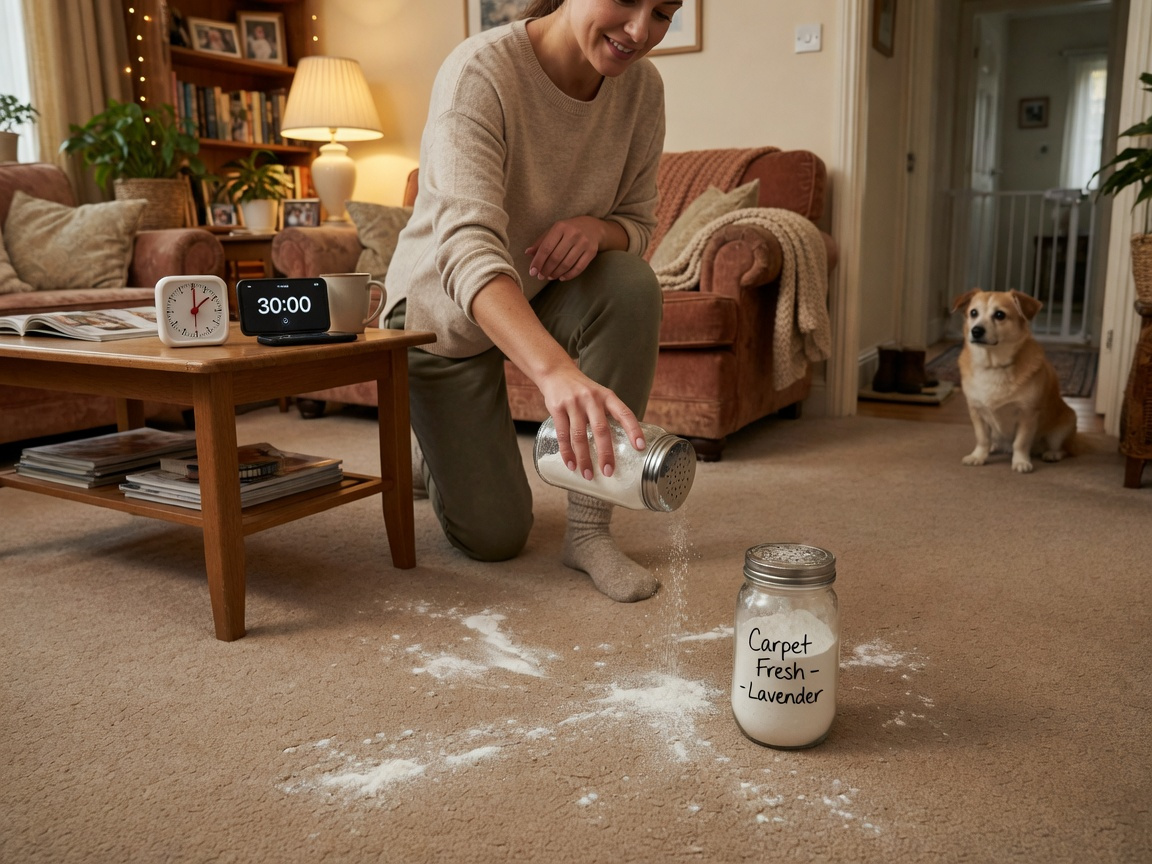
- Leave it for at least 15–30 minutes. Industry testing shows dwell time is critical — powder left for 30 minutes reduces odor compounds by roughly 40% more than powder vacuumed after just five minutes.
- Vacuum thoroughly. Use overlapping passes and go slowly. Most carpet damage from deodorizer powders comes from inadequate vacuuming that leaves residue clumping in the fibers over repeated uses.
- Keep pets out until vacuuming is complete. No exceptions. The risk window runs from application through post-vacuum completion, not just during the application itself.
If you’re combining powder treatment with a deeper wet clean, the collection of DIY carpet cleaning solutions for pet owners includes several natural formulas that work well as a follow-up wet treatment after the dry powder step.
Baking Soda vs. Commercial Carpet Deodorizer Powder: Which One Actually Wins?
This is the most common question in pet owner communities, and the honest answer is: it depends entirely on the severity of your odor situation. Here’s a clear side-by-side breakdown.
| Factor | Baking Soda | Commercial Powder |
|---|---|---|
| Cost per use | Very low (pennies per treatment) | Moderate ($0.50–$2.00 per treatment) |
| Odor neutralization | Good for light, surface odors | Strong, including deep-set and recurring odors |
| Pet safety | Excellent — no additives or fragrance | Varies widely — check ingredient list carefully |
| Fragrance | None (completely neutral) | Usually fragrant, some fragrance-free options |
| Effectiveness on urine | Limited — addresses surface only | High with enzymatic formulas |
| Duration of freshness | 24–48 hours typical | 5–7 days typical |
| Residue risk | Low — fine grain dissolves easily | Moderate if under-vacuumed |
Baking soda wins on safety and cost. For weekly maintenance in a home with minor pet odors, it does a solid and respectable job. But for homes with regular accidents, multiple pets, or older carpets that have absorbed years of odors, a commercial enzymatic powder is genuinely worth the extra investment. The enzymes do work that baking soda simply cannot — breaking down the uric acid crystals that cause odors to return again and again regardless of how often you clean.
Can You Make Your Own Carpet Deodorizer Powder at Home?
Yes — and it works better than most people expect. A DIY carpet deodorizer powder is especially appealing for pet owners who want complete control over the ingredient list. No mystery fragrance blends. No undisclosed essential oils. Just simple, known ingredients with predictable safety profiles.
Here’s a solid base recipe widely used in pet owner communities:
- 1 cup baking soda (primary odor neutralization)
- ½ cup cornstarch (moisture absorption, smooth texture for even spreading)
- ¼ cup food-grade diatomaceous earth (optional — enhances absorption and may supplement flea deterrence)
- 10–15 drops of a vet-cleared essential oil (optional — lavender at very low concentrations is generally tolerated by dogs; skip entirely for cat households)
Mix all dry ingredients thoroughly before adding any essential oil. Store in a sealed glass jar with a shaker lid. Shake well before each use. The batch covers roughly 100 square feet of carpet per cup of mixture.
One important caution: even lavender can cause issues in high concentrations or with particularly sensitive animals. When in doubt, skip the oil entirely — the baking soda and cornstarch base is genuinely effective on its own, and fragrance-free is always the safest choice for multi-pet households. For a complete picture of which cleaning approaches are safe across different pet types and situations, the guide on whether carpet cleaning is safe for pets covers every scenario you’re likely to encounter.
How Often Should You Actually Use Carpet Deodorizer Powder?
Frequency should match your specific pet situation rather than a universal blanket schedule. Here’s a practical framework that accounts for the real range of pet households:
- 1 pet, no accidents, light shedding: Every 2–4 weeks as maintenance is plenty. Fold it into your regular vacuuming routine.
- 1–2 pets, occasional accidents: Weekly treatment of high-traffic areas and sleeping spots. Spot-treat accident areas immediately regardless of schedule.
- 3+ pets or frequent accidents: Twice-weekly treatment with a commercial enzymatic powder. Spot-treat any accident within 30 minutes — the sooner you act, the less the odor penetrates the carpet backing.
- Senior pets with incontinence: Daily powder in high-risk areas plus a wet enzymatic cleaner after each accident. Powder alone won’t keep pace with heavy ongoing contamination.
Over-using powder isn’t harmless. Excessive buildup in carpet fibers causes stiffness, creates a sticky residue that traps more dirt over time, and means your pet repeatedly walks across a heavily powder-coated surface before you vacuum. Regular but not excessive use is the goal — consistent application beats occasional heavy-handed treatments.
What Do Cleaning and Pet Professionals Say About Carpet Deodorizer Powders in 2026?
Perspectives from professionals at the intersection of pet care and carpet cleaning converge on a few consistent points — with some genuinely useful nuances between them.
Both experts agree that the powder-and-vacuum routine works best as part of a layered cleaning strategy — not as a standalone fix. For homes dealing with serious odor problems, powder treats the surface while a wet enzymatic cleaner addresses deep-fiber contamination. Neither step alone achieves what both steps together consistently deliver.
Case Study: How a Multi-Pet Household Cut Carpet Odor by 80% in Four Weeks
A household in Portland, Oregon with three rescue dogs and two cats — all living primarily indoors — documented their carpet odor reduction over four weeks in early 2026. Their starting point was a persistent ammonia smell throughout the main living areas despite regular vacuuming and occasional spot cleaning.
Their protocol combined an enzymatic commercial powder applied twice weekly with an immediate spot-treatment routine for any accidents using a wet enzymatic spray. They vacuumed with a HEPA-filter machine, making two slow, overlapping passes over every treated section.
- Week 1: Noticeable reduction in ammonia odor after just two applications. Background smell shifted from “strong pet odor” to “light pet odor.”
- Week 2: Visiting friends commented on the improvement without being asked. Spot accidents no longer reactivated background odors as strongly as before.
- Week 3: Odor described as “barely noticeable except right after a fresh accident.” Maintenance protocol reduced to once-weekly treatment on main areas.
- Week 4: Self-reported 80% odor reduction compared to the starting baseline. Maintained from that point with weekly powder treatment and rapid accident response.
The critical factor was the combination of enzymatic powder and rapid accident response — the powder alone, without the wet enzymatic spot treatment, would have produced a much slower result. No single product fixed everything. The protocol did.
What Are the Biggest Trends in Carpet Deodorizer Powder for 2026–2027?
The carpet deodorizer category has moved fast in recent years. Several shifts reshaping the market right now will define what’s on shelves through 2027 — and knowing them helps you shop smarter today.
1. Enzymatic formulas are becoming the standard, not the premium. As consumers have become more educated about how odor elimination actually works, enzyme-based powders have shifted from specialty products to mainstream retail offerings. Industry analysis from 2025–2026 shows the enzymatic segment growing at roughly 14% annually — more than double the broader carpet care market’s growth rate.
2. Fragrance-free is gaining serious commercial ground. Growing awareness of essential oil toxicity in pet households — combined with a broader trend toward scent-free household products — is pushing manufacturers to develop effective unscented formulas. In 2026, fragrance-free options represent a meaningfully larger share of new product launches than they did five years ago.
3. Sustainability has become a real purchasing factor. Plant-derived ingredients, biodegradable packaging, and formulas without synthetic surfactants are increasingly important buying criteria, especially among Millennial and Gen Z pet owners. Several established cleaning brands launched certified-sustainable deodorizer lines in 2025–2026 specifically to meet this demand.
4. Pet-specific certifications are emerging as a category differentiator. Independent testing organizations are beginning to offer dedicated pet-safe certifications for carpet products — similar to how infant-safe or allergy-safe product certifications work in adjacent categories. By 2027, expect these labels to be a standard factor in purchasing decisions both online and at retail.
Frequently Asked Questions About Carpet Deodorizer Powder
Can I use any carpet deodorizer powder if I have cats?
Not safely. Cats are particularly sensitive to essential oils through both inhalation and skin absorption. Always check the ingredient list for essential oils — especially tea tree, eucalyptus, clove, cinnamon, and peppermint — before using any deodorizer powder in a home with cats. Choose fragrance-free formulas or products that fully disclose every ingredient and have been specifically cleared for use around felines.
How long should I leave carpet deodorizer powder on before vacuuming?
A minimum of 15 minutes, and ideally 30 minutes or more. Dwell time is the single biggest factor separating effective treatments from ineffective ones. If you can apply the powder before running an errand and vacuum when you return, you’ll get significantly better results than treating and immediately vacuuming — with zero additional effort.
Will carpet deodorizer powder damage my vacuum cleaner?
Fine-grain powders can strain a vacuum’s motor and clog its filter over time if used heavily or if the vacuum lacks adequate filtration. Always use a vacuum with a HEPA filter when picking up carpet powder, and clean or replace the filter after each use. Avoid very fine-grain powders with bagless vacuums that have weak suction — the powder can compact and block the filter rapidly.
Does carpet deodorizer powder actually remove stains?
No. Carpet deodorizer powder handles odors only — it is not a stain remover. For stains, you need a wet treatment: either a commercial enzyme cleaner or a DIY formula matched to the specific stain type. Applying dry powder to a fresh, still-wet stain can cause it to spread and set more deeply into the fiber. Always deal with stains using a wet treatment first, then use powder once the area has fully dried.
Is baking soda safe for all carpet types?
Baking soda is safe for the most common carpet fiber types, including nylon, polyester, and olefin. For wool or other delicate natural-fiber carpets, very frequent use can potentially affect the natural oils in the fiber over time. On natural-fiber carpets, use baking soda sparingly and vacuum thoroughly after each treatment to remove all residue before it has a chance to build up.
Can carpet deodorizer powder help with flea prevention?
Food-grade diatomaceous earth added to a DIY powder mix has documented efficacy against fleas by dehydrating their exoskeleton on contact. That said, it should not be your primary flea-control strategy — consult your veterinarian for a proper prevention protocol. Think of diatomaceous earth in your carpet powder as a supplementary layer, not a replacement for veterinary-recommended flea treatments.
What’s the difference between carpet deodorizer powder and carpet cleaning powder?
Carpet deodorizer powder is designed exclusively for odor control. Carpet cleaning powder (sometimes called dry carpet cleaner) contains surfactant compounds that attract and absorb soiling so it can be vacuumed away with the dirt. Some products combine both functions. If your carpet has both soiling and odor, a dry carpet cleaner with added enzymatic deodorizers is the more efficient single-product approach.
What’s Your Next Move? A Simple Five-Step Action Plan
Carpet deodorizer powder is one of those products where the difference between a great result and a disappointing one comes down almost entirely to choosing the right formula for your situation and using it correctly. Here’s a clean action plan to put this into practice starting this week.
- Assess your odor level honestly. Light background odor → baking soda-based DIY mix is sufficient. Persistent ammonia smell that keeps returning → invest in an enzymatic commercial powder.
- Audit your current products. Check the ingredient list on anything already in your cleaning cabinet. If you find essential oils and you have cats, replace those products before the next treatment.
- Run one full correct treatment this week. Apply the powder, wait a full 30 minutes, then vacuum thoroughly with a HEPA-filter machine. Compare the result to how you’ve been doing it — the difference is usually noticeable immediately.
- Set a maintenance schedule and protect it. Weekly for multi-pet homes, every two to four weeks for lighter situations. Consistent treatment at the right interval outperforms occasional heavy treatment every time.
- Implement the 30-minute accident rule. Any pet accident gets spot-treated within 30 minutes of discovery. This single habit makes every other part of the protocol significantly more effective by preventing odors from reaching the carpet backing in the first place.
Getting your carpets genuinely fresh — not just temporarily masked — is a realistic and achievable goal for any pet household in 2026. It requires the right products, the right technique, and a consistent routine. Start simple, track your results, and adjust based on how your specific pets and carpet type respond over the first few weeks.